

Anxiety is distress, not disobedience. The most useful starting point is to notice when a dog struggles, reduce the pressure and work with a veterinarian to understand the cause. A single bark, yawn or photograph cannot establish an anxiety disorder. [1, 2, 5]
This guide explains common patterns, contributing factors, visible behaviours and treatment principles. It includes real photographs and research statistics with their limits. It is general information for an Australian audience, not an assessment of an individual dog, and it has not been veterinary reviewed.
Fear, anxiety and phobias
- Fear is a response to an immediate perceived threat, such as an approaching dog or a sudden loud noise.
- Anxiety is anticipation of something worrying, including a situation that has not yet happened.
- A phobia is an excessive, persistent fear. Fear and anxiety can overlap, and a dog can have more than one difficulty. [1]
What matters most
- Look at the whole dog and the situation. Compare behaviour with that dog’s usual relaxed state, rather than relying on one body-language signal.
- Rule out health problems. Pain, illness, sensory loss and age-related changes can cause or intensify behaviour changes. [1, 3]
- Make daily life easier while learning happens. Avoid overwhelming exposures and punishment; treatment usually combines management and gradual, reward-based behaviour work. [7]
- Seek help early when distress disrupts normal life. Medication may be part of a veterinary plan, not a failure of training. [8, 9]
When help is urgent
Contact a veterinarian promptly for self-injury, dangerous escape attempts, serious aggression or persistent severe distress. A sudden marked behaviour change also warrants medical attention. If someone is at immediate risk, calmly create distance and use barriers rather than handling or cornering the dog. [3, 6, 8]
Common patterns and contributing factors
These are useful organising categories, not mutually exclusive diagnoses. Similar signs can have different causes, so the timing and context matter. [1-4]
| Pattern | Typical context | Behaviours that may be seen |
|---|---|---|
| Separation related distress | Before or during time away from a person or when left alone | Pacing, vocalising, drooling, toileting, destruction or escape attempts |
| Noise fear or aversion | Fireworks, thunder, traffic, machinery or household sounds | Trembling, hiding, panting, escape behaviour or difficulty settling |
| Social or situational fear | People, other dogs, handling, vet visits or unfamiliar places | Avoidance, lowered posture, freezing or defensive behaviour |
| Generalised anxiety | Apprehension across situations rather than one clear trigger | Vigilance, restlessness and difficulty relaxing |
| Health or age associated changes | Pain, disease, sensory changes or cognitive dysfunction | New fear, night waking, confusion, restlessness or altered social behaviour |
Why it can develop
There is rarely one universal cause. Inherited predispositions, early development, limited positive socialisation, frightening experiences and medical problems can contribute. These are risk factors, not destiny: neither a breed label nor an unknown background proves an anxiety disorder. [1]
Changes in routine, household or environment may be relevant, but a change occurring before a problem does not establish its cause. Several factors can interact, and an assessment should consider health, learning history and the current environment. [1, 2, 4]
Avoid jumping to the wrong explanation
Destruction during an absence does not by itself mean separation anxiety; insufficient stimulation or other problems can also contribute. Barking might be directed at something outside. A safely positioned camera can help reveal when behaviour starts, what happens around it and whether the dog can settle. [4]
New night waking, house-soiling or disorientation in an older dog should not be dismissed as “just anxiety”. Cognitive dysfunction is one possibility, but other medical conditions can produce similar changes. [3]
What behaviour can look like
These real photographs illustrate movements or postures, not diagnosed anxiety cases. Read the whole body, the situation and changes from the dog’s normal behaviour. One still image cannot show what happened before or how long a behaviour lasted. [5, 6]
Lowered and tucked posture

Photo: Ellen Levy Finch / Wikimedia Commons · CC BY-SA 4.0. Displayed at reduced size; no crop or content edits.

Lip licking

Photo: Nishi.LovesBees / Wikimedia Commons · CC BY-SA 4.0. Displayed at reduced size; no crop or content edits.

Yawning

Photo: Nishi.LovesBees / Wikimedia Commons · CC BY-SA 4.0. Orientation normalised for upright display; resized for display; no crop.

Other signals to notice
Subtle changes may include turning away, avoiding eye contact, ears held back, a raised paw, a lowered body or a tucked tail. More obvious distress may involve trembling, hiding, pacing, drooling, repeated vocalising or difficulty settling. [5, 6]
Panting can accompany distress, but heat, exercise and health problems are other explanations. A cluster of changes, repeated in a particular context, is more informative than an isolated signal. Record observations rather than assigning an emotion with certainty. [1, 5]
Respect warnings and give space
Stiffening, staring, growling, showing teeth, snapping or lunging can signal a need for distance. Do not punish the warning or force an approach. Create space and seek professional advice about safety and the underlying cause. [6, 7]
For a real-photo example of visible eye whites, see ASPCA Canine Communication page 31. This reference is linked, not reproduced. Visible eye whites alone do not prove anxiety.
Treatment options and what helps
There is no single treatment for every dog. A plan should address the cause, reduce current distress and build coping skills at a manageable pace. [1, 7]
Start with a veterinary assessment
A history and physical examination help identify pain, illness or other conditions that may contribute. This is especially important for a sudden change or an older dog. The vet may recommend further investigation or referral to a veterinary behaviourist for complex or severe cases. [1, 3, 8]
Reduce pressure in daily life
Provide a quiet retreat the dog can choose to use, predictable routines and suitable activities. Increase distance from frightening situations instead of forcing interaction. If absences cause distress, arrange support to reduce time alone beyond the dog’s current ability to cope. Confinement is not automatically reassuring; a crate can worsen distress in some dogs. [2, 8]
Build new associations gradually
Desensitisation introduces a trigger at an intensity the dog can handle, such as greater distance or lower sound volume. Counterconditioning pairs the trigger with something the dog enjoys. Difficulty increases gradually, guided by the dog’s response. If distress appears, reduce the challenge rather than pushing through it. [7]
For separation work, initial practice absences may last only seconds. Video can help check whether the dog remains comfortable, and a professional can tailor the starting point and progression. Progress follows the dog, not a fixed deadline. [8]
Avoid flooding, where a frightened dog is forced to endure an overwhelming trigger. Punishment can add fear or provoke defensive responses; it does not address the underlying distress. [7]
Discuss medication with the vet
Medication can reduce suffering and support learning alongside an appropriate behaviour plan. Examples used in behavioural medicine include fluoxetine and clomipramine; other medicines may be chosen for individual needs or specific events. These are examples, not a recommendation or an Australian approval list. [9]
An Australian veterinarian must decide what is suitable and available, assess interactions and arrange monitoring. Do not give human medication, copy another dog’s prescription or alter prescribed treatment without veterinary advice. No doses are provided in this guide.
Treat calming products as possible adjuncts
Evidence varies between products; “natural” is not a guarantee of effectiveness or safety. CBD evidence remains limited and product-specific, and product quality can vary. Discuss supplements and other calming products with the vet rather than allowing them to delay effective care. [10]
Useful observations for a behaviour plan
A short factual record can make a veterinary appointment more useful. The aim is to notice patterns without deliberately provoking fear. These notes are not a diagnostic test or a substitute for assessment. [1, 4]
Record what happened
| Record | Useful detail |
|---|---|
| Situation | Where was the dog, who was present and what happened just before the behaviour? |
| Timing | When did it begin, how long did it last and how long before the dog settled? |
| Visible behaviour | Describe actions: “paced between the door and window” is more useful than “was naughty”. |
| Trigger and distance | Note the sound, person, dog, handling or absence, and how close or intense it was. |
| Response to help | What changed when distance increased, the trigger stopped or a person returned? |
| Health and routine | Note sleep, appetite, toileting, mobility, medication and recent changes for the vet. |
Use video safely
For concerns during absences, a camera can reveal signs that are otherwise missed. Share a brief, representative clip with the vet and note the time from departure to the first sign. Do not prolong an absence or recreate a frightening event just to obtain footage. [4, 8]
Make the first steps achievable
- Identify the situations that appear difficult and temporarily reduce avoidable exposure.
- Keep access to a quiet resting place and give the dog room to move away.
- Ask the vet what medical causes need checking and what changes are safe to begin now.
- Agree on realistic goals and how progress will be measured. Fewer severe episodes, easier recovery and better ability to settle may all matter. [1, 2, 7]
Questions to take to the vet
Could pain or illness be contributing? Is referral to a veterinary behaviourist appropriate? What should we avoid while treatment starts? Would medication help this dog, and what monitoring is needed? How should we adjust the plan if distress increases?
If the dog is injuring itself, escaping dangerously, showing serious aggression or remaining severely distressed, seek prompt professional help rather than waiting for training to work. [8]
How common are these behaviours?
In a 2020 Finnish owner survey of 13,715 dogs, these behaviours were reported at high levels:
About 1 in 3
Noise sensitivity · 32%
In this survey, owners reported frequent fear reactions to sounds.
About 3 in 10
Fearfulness · 29%
In this survey, owners reported frequent fear of unfamiliar dogs, strangers or new situations.
About 1 in 4
Fear of fireworks · 26%
In this survey, owners reported frequent fear reactions to fireworks.
A dog afraid of fireworks can appear in both the fireworks and noise figures. Do not add the percentages together.
These are owner-reported survey findings, not veterinary diagnoses or estimates for all Australian dogs. “High” means fear was reported often or more frequently—not just once. Study source
Study details and a separate UK finding
The Finnish survey recruited mainly through Facebook and breed organisations, not a random population sample. “Often” meant fear in 40–60% of relevant encounters; more frequent fear also qualified. Figures are rounded. Salonen et al. (2020)
A different question: behaviour when left alone
A separate UK study of 1,807 dogs found that 22.1% had at least one owner-reported separation-related behaviour before the first COVID lockdown. Examples included barking, pacing or toileting when alone or about to be left. This is not a diagnosis of separation anxiety, and its different definition means it should not be compared directly with the Finnish figures. Harvey et al. (2022)
UK participants volunteered online and recalled earlier behaviour; dogs under 12 months and those not left alone at baseline were excluded. The pandemic context also limits how widely the finding applies.
Can breed influence susceptibility?
Yes, breed differences have been reported for specific fears, but there is no single ranking of “anxious breeds”. These examples come from Finnish owner surveys, not Australian prevalence estimates. They do not mean every dog of these breeds will be affected. [11, 13]
All four photographs show representative breed examples only. None is presented as a dog diagnosed with anxiety.
Lagotto Romagnolo
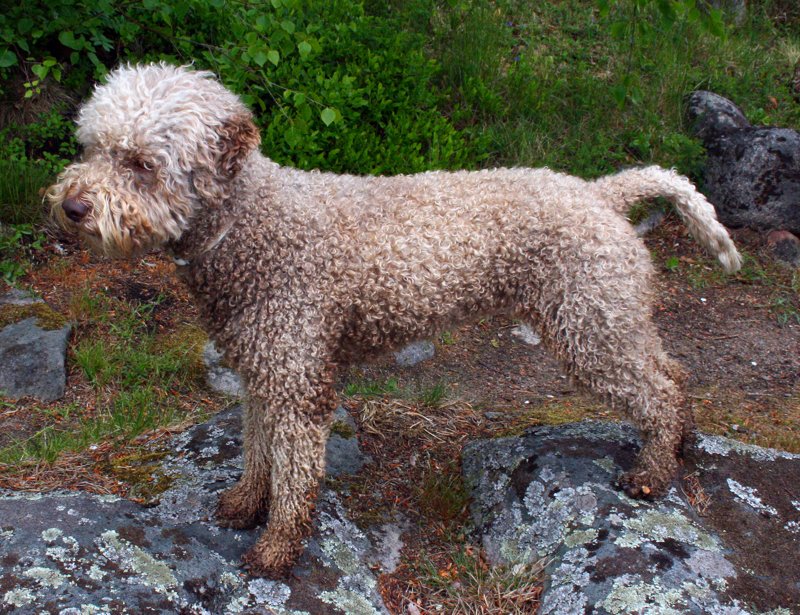
Photo: Entheta / Wikimedia Commons · CC BY-SA 3.0. Resized and compressed; no crop or content edits.

Noise sensitivity was reported relatively often in this breed in Salonen et al. [11]
Chihuahua

Photo: Bonnie van den Born / Wikimedia Commons · Creator website · CC BY-SA 3.0. Compressed and resized for display; no crop or content edits.

Fear of unfamiliar dogs was reported more often in this breed in Puurunen et al.; this is not a claim about every type of anxiety. [13]
Shetland Sheepdog
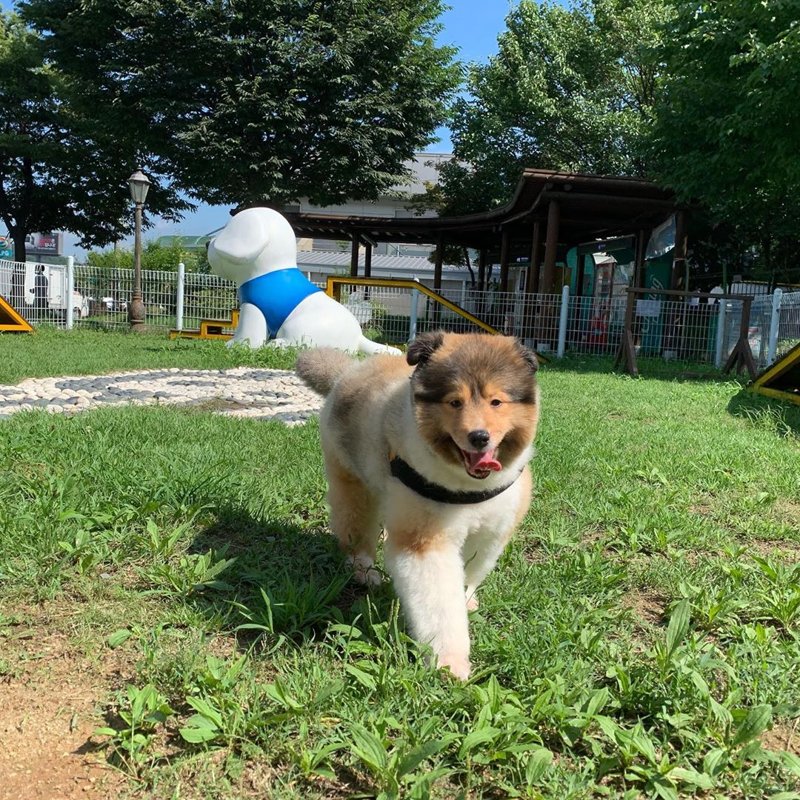
Photo: Liasmith93 / Wikimedia Commons · CC BY-SA 4.0. Resized and compressed; no crop or content edits.

Fear of unfamiliar dogs and strangers was reported more often in this breed in Puurunen et al. [13]
Spanish Water Dog
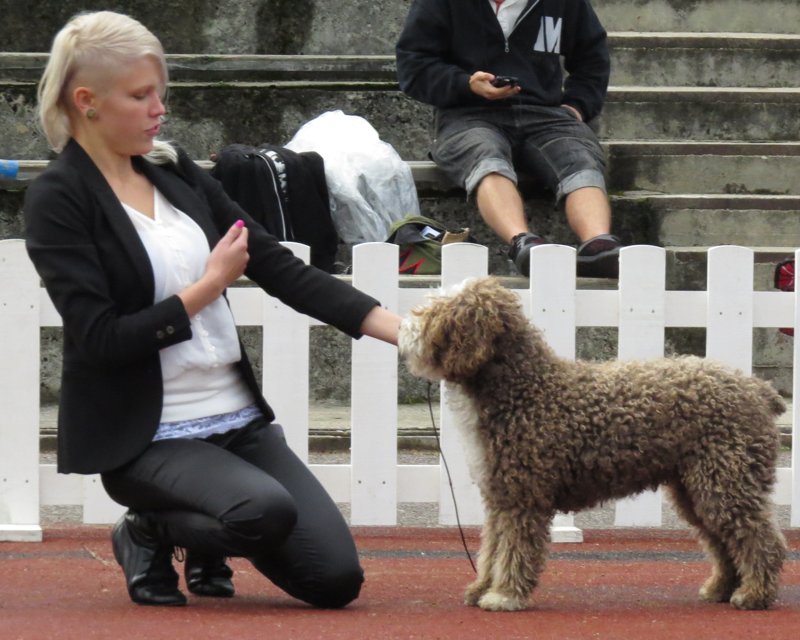
Photo: Томасина / Wikimedia Commons · CC BY-SA 3.0. Resized and compressed; no crop or content edits.

Fear of unfamiliar dogs and strangers was reported more often in this breed in Puurunen et al. [13]
Interpretation: Puurunen analysed 5,973 dogs for fear of dogs and 5,932 for fear of strangers. Owners reported behaviour; these were not individual clinical diagnoses. Both papers use overlapping Finnish survey data, not independent replication. Breed is only one factor alongside health, experience and environment. [1, 11, 13]
Sources
Sources checked on 1 November 2026. Numbered references support this guide. Research findings and clinical guidance serve different purposes.
[1] Merck Veterinary Manual. Behaviour problems of dogs
[2] Cornell Riney Canine Health Center. Anxious behaviour and unsettling situations
[3] AAHA senior care guidance. Cognitive dysfunction and behavioural anxiety
[4] RSPCA UK. Separation related behaviour
[5] ASPCApro. Canine body language tips
[6] RSPCA UK. Understanding dog behaviour
[7] Merck Veterinary Manual. Treatment of behaviour problems in animals
[8] AAHA. Separation anxiety in pets
[9] Merck Veterinary Manual. Behaviour modification in dogs
[10] Cornell Riney Canine Health Center. CBD uses and efficacy
[11] Salonen et al. 2020. Prevalence comorbidity and breed differences in canine anxiety in 13715 Finnish pet dogs
[12] Harvey et al. 2022. Impact of changes in time left alone on separation related behaviour
[13] Puurunen et al. (2020). Inadequate socialisation inactivity and urban living environment are associated with social fearfulness in pet dogs. Scientific Reports 10, 3527.