
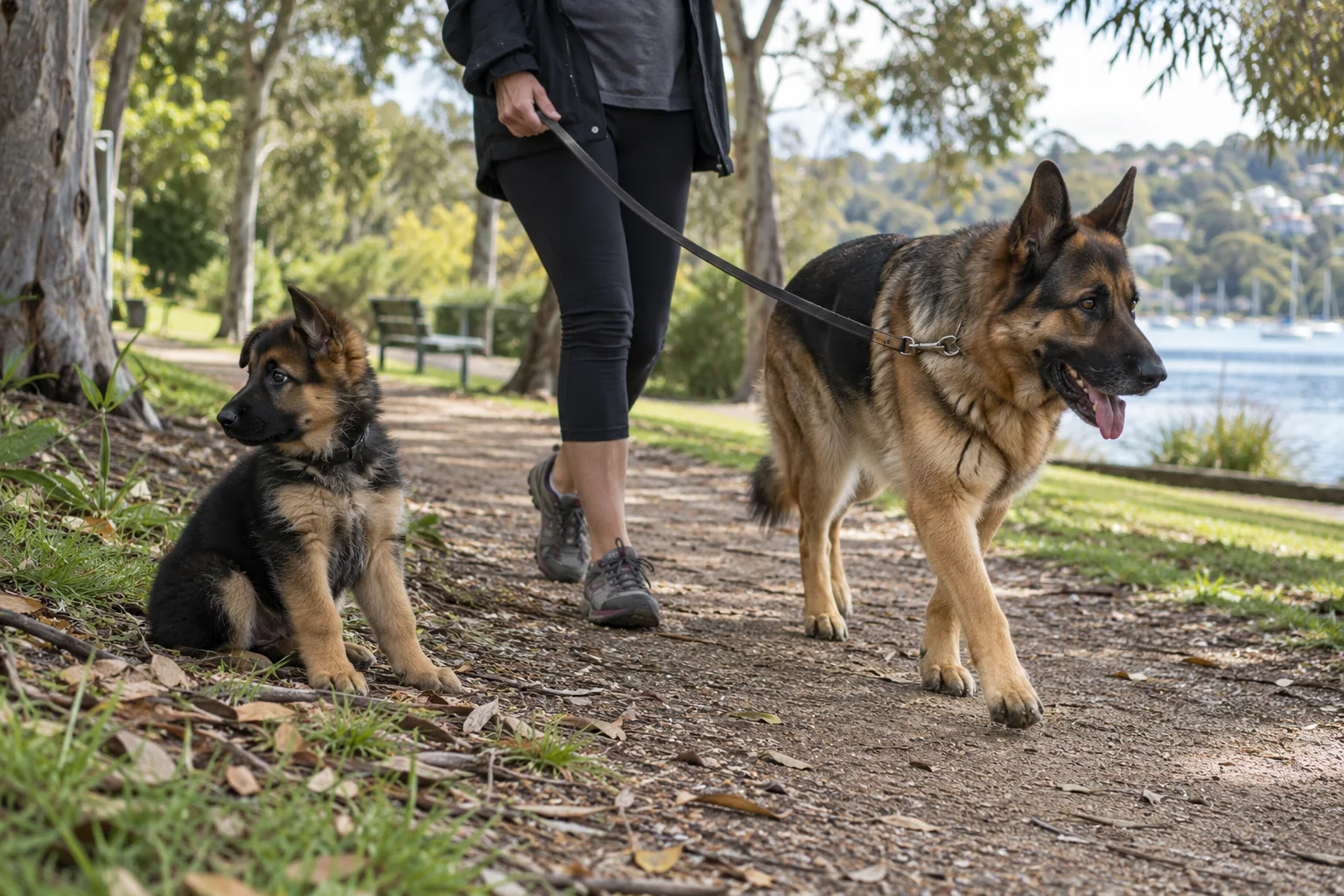
The German Shepherd Dog was developed as a versatile herding and working breed. Dogs Australia describes the ideal dog as self-assured, steady and willing to please. Those qualities do not arrive fully trained: a large, observant adolescent needs guidance, safe socialisation and meaningful daily activity.
- Typical fit: experienced or well-supported owners who enjoy structured training
- Activity: substantial daily physical and mental work
- Coat: dense double coat in stock and long stock varieties; expect shedding
- Training: highly capable, best with calm clarity and rewards
- Big commitment: responsible sourcing, joint care, socialisation and secure management
Temperament and socialisation
A well-bred German Shepherd should be confident rather than indiscriminately reactive. Puppies need gentle exposure to normal life—people, traffic, surfaces, handling and calm dogs—at a level where they can observe and recover. Socialisation does not mean encouraging every stranger to touch the puppy.
Fear, guarding and lunging can become difficult to manage in a powerful adult. Do not use intimidation to “show who is boss.” Seek early help from a qualified reward-based professional and a veterinarian, particularly when behaviour changes suddenly.
Exercise and mental work
Healthy adults usually need varied daily exercise plus a job for the brain. Walking, sniffing, tracking, obedience skills, retrieving and appropriate dog sports can all contribute. A backyard is useful but does not replace interaction. Puppies need shorter, age-appropriate sessions and should not be pushed through repetitive jumping or long forced runs while growing.
Teach an off-switch alongside activity. Mat training, quiet chewing and predictable rest help prevent a household from becoming a constant high-alert workplace.
Training priorities
Start recall, loose-lead walking, leave, comfortable handling, calm visitor routines and vehicle manners early. Reinforce the behaviour you want before the dog becomes large enough to drag, jump or block. German Shepherds often notice small inconsistencies, so keep cues clear and make desired choices worthwhile.
Coat and Australian conditions
Both coat varieties have a weather-resistant double coat. Brush regularly and expect heavy seasonal shedding. Check ears, nails, paws, teeth and skin as part of routine care. Do not shave a healthy double coat simply for summer; provide shade, water, airflow and exercise during cooler hours instead. Discuss medical clipping or severe matting with a vet or experienced groomer.
Health and breeder checks
Ask for hip and elbow assessment results for both parents, not just a statement that they were checked. Discuss degenerative myelopathy testing, digestive disease, skin problems and temperament in the wider family. Testing manages risk but cannot guarantee an individual puppy’s health.
The German Shepherd Dog Council of Australia’s accredited Breed Survey evaluates dogs from 18 months for temperament, character, anatomy, movement and soundness. Ask breeders what survey and health information is available, and why they selected the particular pairing.
Is a German Shepherd right for you?
This breed may suit someone who wants a close working partnership, has room for a large dog and enjoys ongoing education. It may be a poor fit when long days alone, inconsistent boundaries, insecure fencing or limited capacity for training are unavoidable. Budget for quality food, equipment, training, grooming and the higher veterinary costs that often accompany a large dog.